Tyrannus Online Seminary
Site blog
 DAILY REFLECTION
11 Sept 2026
“What good is it for someone to gain the whole world, yet forfeit their soul?”
Mark 8:36
In recent years, Malaysians have watched with sadness as several former national leaders have faced serious corruption charges and allegations involving the misuse of public funds. Men who once occupied the highest offices of the nation have found their reputations and legacies overshadowed by questions of integrity and accountability.
Whatever the final judgment in each individual case, these events confront us with a timeless question asked by Jesus:
“What good is it for someone to gain the whole world, yet forfeit their soul?”
Jesus was not teaching that wealth, influence or leadership are wrong. The danger comes when what we possess begins to possess us—when the desire for more wealth, greater power or higher status becomes stronger than our commitment to truth and righteousness.
A person may gain position, possessions, recognition and influence and still lose something infinitely more valuable: the integrity of the soul.
This warning is not only for politicians. It is for all of us.
Every person with influence faces choices. A businessman may be tempted to compromise for profit. A leader may protect his position at the expense of truth. A Christian worker may pursue recognition rather than faithfulness. Even in ordinary life, we can slowly exchange our convictions for convenience, acceptance or personal advantage.
The greatest danger is that compromise rarely begins with one enormous decision. It often begins with small choices that gradually silence the conscience.
That is why character matters.
Leadership is not merely about how much authority we possess, but what we do with the authority entrusted to us. Public office, business success, ministry leadership and personal influence are all forms of stewardship. Ultimately, we are accountable not only to people, but to God.
One day, titles will disappear. Positions will be handed to someone else. Wealth will be left behind. Public applause will become silent.
But our character and our accountability before God remain.
So let us ask ourselves: What am I pursuing? What am I willing to compromise to obtain it? And what kind of legacy am I building?
True success is not gaining everything the world can offer. True success is remaining faithful to God while faithfully stewarding whatever He places in our hands.
“Gain the world if God entrusts it to you—but never at the cost of your soul.”
 DAILY REFLECTION
10 Sept 2026
“When evening came, many who were demon-possessed were brought to him, and he drove out the spirits with a word and healed all the sick.”
Matthew 8:16
Yesterday, Pastor Leong shared with me the remarkable testimony of a well-known Taiwanese singer shortly before her passing.
For more than 40 years, Pastor Leong has ministered to people facing spiritual brokenness and bondage. In recent years, his ministry has also extended online, where he connects with people seeking spiritual help and ministers to them through prayer, counselling and deliverance, even when they are separated by distance.
One such person was this Taiwanese singer.
Despite her fame, talent and success, she had endured deep spiritual and emotional struggles for many years. According to Pastor Leong, she believed that a dark spiritual oppression associated with her family history had troubled her since childhood, robbing her of health, peace and joy.
Through Facebook, she eventually connected with Pastor Leong. Although they were not physically together, he ministered to her online and encouraged her to seek God earnestly through fasting, prayer and meditation on Psalm 23.
During this period, she reported a powerful spiritual encounter. She saw visions of Jesus and a white dove, experienced intense physical trembling and began speaking in tongues. She believed that through Christ, the spiritual bondage she had endured for decades was finally broken.
Afterwards, her appetite returned, her appearance improved and, most significantly, peace and joy returned to her heart.
Her testimony brings Matthew 8:16 vividly to mind. People brought those who were suffering to Jesus, and with a word, He drove out evil spirits and healed the sick.
This teaches us an important truth about deliverance: the power is not in the minister, the method, the prayer, or whether ministry takes place physically or online. The authority belongs to Jesus Christ.
Pastors and believers may pray, counsel and minister, but Jesus is the Deliverer.
The gospel declares that Christ came to rescue us from sin and darkness and reconcile us to God. Through the cross and resurrection, He has conquered sin and death and given us the hope of eternal life.
Whatever battle you may be facing—physical, emotional or spiritual—bring it to Jesus, while also seeking appropriate pastoral and medical help.
Come to Jesus. Receive His grace. Trust His authority. Walk in His light.
“In Christ there is freedom, hope and eternal life.”
 DAILY REFLECTION
9 Sept 2026
“From the days of John the Baptist until now, the kingdom of heaven has been subjected to violence, and violent people have been raiding it.”
Matthew 11:12
On September 3, renowned author and Messianic Rabbi Jonathan Cahn found himself in an unexpected and frightening situation aboard American Airlines Flight 618.
According to Cahn, a conversation with the passenger beside him eventually turned to spiritual matters and the gospel. What began peacefully suddenly changed when the man became hostile, and the encounter escalated into physical aggression. Other passengers and crew members eventually intervened.
This incident reminds us of a sobering truth: the gospel of Jesus Christ will not always be welcomed.
Jesus Himself experienced both acceptance and rejection. Crowds came eagerly to hear Him, yet others opposed Him and eventually sought His death. The apostles faithfully proclaimed Christ, but many encountered ridicule, persecution, imprisonment and even martyrdom.
Matthew 11:12 reminds us that the advance of God’s Kingdom has never been without opposition. The gospel offers wonderful grace, forgiveness and hope, but it also confronts the human heart. It calls us to repentance, challenges our pride and invites us to surrender our lives to Christ.
Grace welcomes us, but truth also confronts us.
Yet when the gospel is resisted, Jesus does not call us to respond with anger or retaliation. He teaches us the way of grace.
When insulted, we need not insult in return. When rejected, we continue to love. When opposed, we remain faithful to truth. When hostility arises, we seek to reflect the character of Christ.
This does not mean Christians should remain in dangerous situations or refuse appropriate help. Christian courage is not recklessness; it is faithfulness without retaliation.
Most of us may never experience physical violence for sharing Christ. Yet we may encounter rejection, misunderstanding, criticism or strained relationships because of our faith.
We cannot control how others respond to the gospel, but we can choose how we respond to them.
May God give us courage without aggression, conviction without condemnation, and truth expressed through love. May opposition never silence our witness or harden our hearts toward those who reject us.
“The gospel may be resisted, but it cannot be defeated. Our calling is not to win every argument, but to remain faithful to Christ and reflect His love.”

DAILY REFLECTION
8 Sept 2026
“The light shines in the darkness, and the darkness has not overcome it.”
John 1:5
Yesterday, TOS Board member Bishop Solomon and I had a meaningful conversation with Pastor Arthur Leong about the unique ministry he has faithfully carried for more than 40 years.
Four decades ago, Pastor Arthur sensed God calling him to take the gospel into the red-light districts—places many would rather avoid, where brokenness, exploitation, rejection and hopelessness are often hidden behind closed doors.
He went with a simple conviction: if Jesus is the Light of the world, then His light belongs precisely where the darkness seems greatest.
What began as a courageous step of obedience became a lifetime of ministry. Pastor Arthur has since authored 24 books, sharing lessons and insights gained through decades of evangelism. His journey reminds us that one act of obedience to God can bear fruit far beyond what we initially imagine.
John 1:5 does not deny the reality of darkness. Sin destroys. Shame imprisons. Rejection wounds. Yet Scripture gives us this wonderful assurance: darkness never has the final word when Christ enters the picture.
What particularly struck me about Pastor Arthur’s ministry was his approach. He did not begin with condemnation. He began by listening.
He sat with people, heard their stories and sought to understand the pain behind their circumstances. Many had already experienced years of judgment and rejection. What they needed was someone willing to show them that God had not forgotten them.
This is how Jesus ministered. He never compromised truth, but neither did He withhold compassion. He saw beyond people’s failures to their deepest need—for forgiveness, dignity, hope and a new beginning.
Pastor Arthur’s ministry therefore challenges us: Where is the darkness God is asking us to enter with His light?
It may not be a red-light district. It may be a broken family, a struggling colleague, a lonely neighbour, someone trapped by addiction, or a person society has pushed aside.
The gospel was never meant to remain within the safety of our churches. Light fulfils its purpose when it enters the darkness.
Today, may we ask God for eyes to see those others overlook, hearts willing to listen without condemnation, and courage to carry the love and truth of Jesus wherever darkness remains.
“The darker the night, the more clearly the Light of Christ can shine.”
 DAILY REFLECTION
7 Sept 2026
“She is clothed with strength and dignity; she can laugh at the days to come.”
Proverbs 31:25
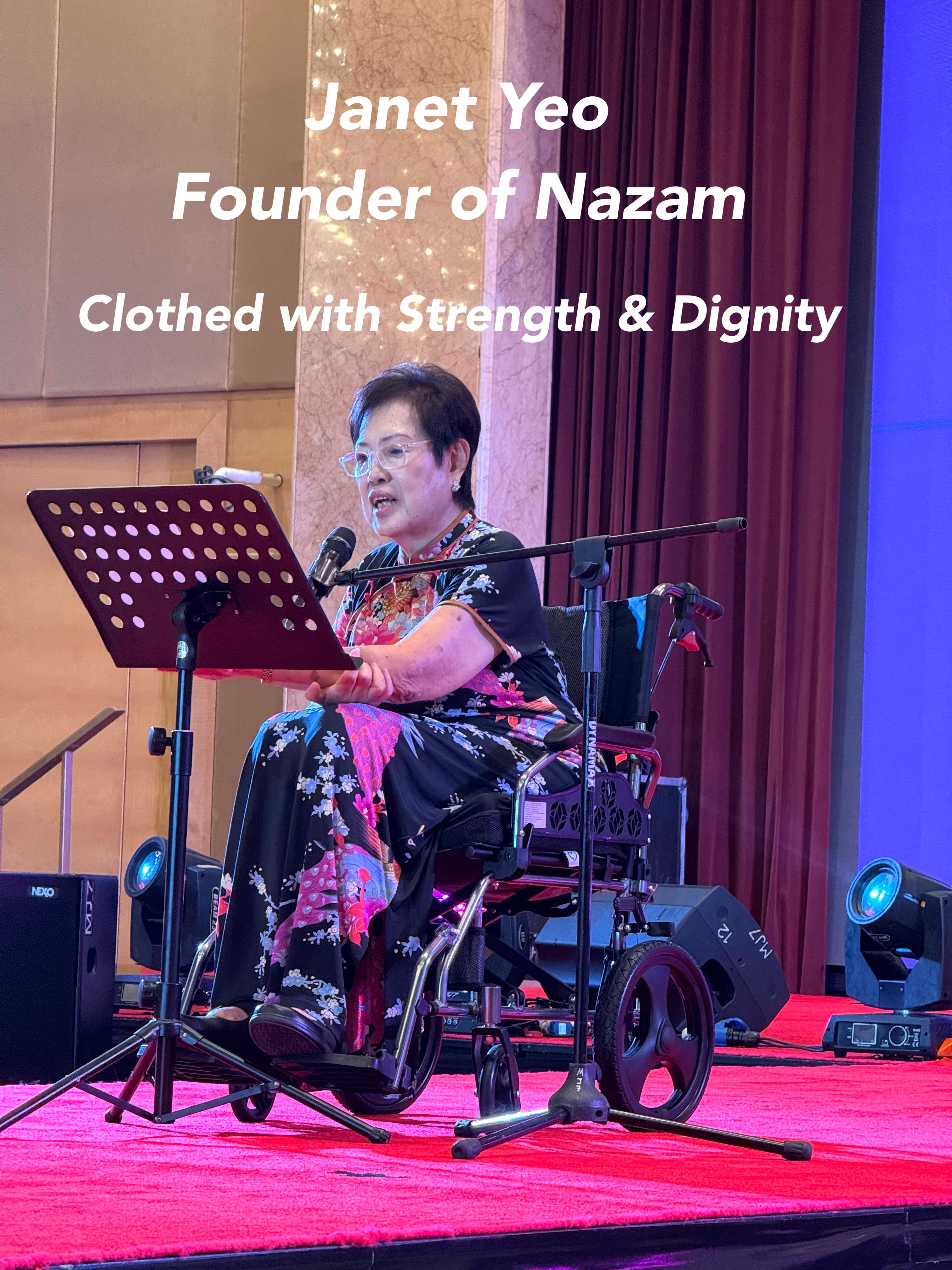
On September 5, my wife and I had the privilege of attending NASAM’s 30th Anniversary Fundraising Dinner, graciously invited by its founder, Janet Yeo.
As I watched Janet, seated in her wheelchair, speak with remarkable strength and conviction, my thoughts turned to Joni Eareckson Tada, the internationally known Christian advocate for people with disabilities. Both women remind us of Proverbs 31:25: strength and dignity are not determined by physical ability or comfortable circumstances, but by what anchors us when life becomes difficult.
Janet’s journey began with a life-changing stroke in 1989, leaving her partially paralysed and affecting her speech. What could easily have become a story of despair instead became a story of courage and purpose.
Through years of demanding rehabilitation, perseverance and God’s sustaining grace, Janet gradually rebuilt her life. But she did something more: she turned her pain into a pathway of hope for others.
In 1996, she founded NASAM to provide stroke survivors with the rehabilitation, encouragement and community she herself had desperately needed. Thirty years later, what began from one woman’s suffering has become a ministry of compassion and hope to countless others.
This teaches us an important spiritual truth: God may not always remove our difficulties, but He can give us strength to rise above them and even use our wounds to bless others.
Janet’s life reminds us that we are not defined by what happened to us, but by how, with God’s help, we respond to it.
When God clothes us with strength and dignity, we can face tomorrow with faith instead of fear, purpose instead of despair, and hope instead of defeat.
Perhaps today you are facing circumstances you never expected—a health crisis, family difficulty, financial setback, disappointment or painful loss. You may wonder, “How can I face tomorrow?”
Proverbs 31:25 gives us the answer. We face tomorrow not because we know what it holds, but because we know the God who holds tomorrow.
“When surrendered to God, even our deepest wounds can become places where His grace shines most brightly.”
 DAILY REFLECTION
4 Sept 2026
“Now it is required that those who have been given a trust must prove faithful.”
1 Corinthians 4:2
Faithfulness is easy to speak about when life is going well. Its true depth is often revealed when life becomes difficult and costly.
In 2006, when Edmund suddenly lost his beloved wife, he was left to raise their three young children alone. Amid his grief, he faced the enormous responsibility of becoming their caregiver, provider and emotional anchor.
In that painful season, Edmund made a deeply personal decision: he would remain single and devote himself wholeheartedly to raising his children. Friends and family encouraged him to consider remarriage, hoping companionship would ease his burden. While Scripture permits remarriage after the death of a spouse, Edmund personally chose another path—one he believed reflected his commitment to the family God had entrusted to him.
There were lonely nights, financial pressures, emotional struggles and the daily demands of raising three children. Yet Edmund persevered. His trust in God gave him strength to continue when the responsibility must have felt overwhelming.
His children did not merely hear their father speak about faithfulness—they watched him live it. They saw a father who remained steadfast when life became difficult, a provider who faithfully carried his responsibilities, and a man who placed their needs before his own comfort.
Today, his children have grown into strong and grounded adults. They carry with them the legacy of a father whose life demonstrated perseverance, sacrifice and love.
This is the heart of 1 Corinthians 4:2: God calls us to be faithful with what He has entrusted to us.
Each of us has been given something to steward—our family, marriage, children, ministry, career, resources, gifts or influence. Faithfulness means honouring these responsibilities even when the journey becomes difficult and no one applauds us.
God does not measure our lives merely by visible success. He looks for faithfulness.
Perhaps the question for us today is simple: What has God entrusted to me, and am I being faithful with it?
“Faithfulness is proven not when the journey is easy, but when we continue to honour God even when it becomes difficult.”
 DAILY REFLECTION
3 Sept 2026
“The Lord is close to the brokenhearted and saves those who are crushed in spirit.”
Psalm 34:18
Just two days ago, I wrote about YB Hannah Yeoh, reflecting on meekness from Matthew 5:5 and how we can remain faithful to our convictions while serving others with humility and grace.
Yesterday I was deeply saddened to learn that her marriage of 18 years has ended in divorce. Without knowing the private circumstances, it is neither our place to speculate nor to judge. Instead, this news reminds us that behind every public figure is a human heart, and behind every broken relationship are people who need grace, prayer and compassion.
Eighteen years of marriage represents a long journey of shared memories, dreams, joys and struggles. When such a relationship ends, the pain can be profound—not only for the couple, but also for their children and those closest to them.
Psalm 34:18 offers a beautiful promise: “The Lord is close to the brokenhearted.”
The Scripture does not say God is close only when everything is going well. He draws especially near when our hearts are broken and our spirits crushed.
Separation can feel like losing more than a relationship. It may involve grieving shared dreams, familiar routines and a future once imagined together. Yet in such moments, God does not abandon us in our brokenness. He meets us there.
His presence becomes a refuge where tears need not be hidden, questions need not have immediate answers, and healing does not need to be rushed.
As fellow believers, our response to someone experiencing marital brokenness should therefore not be gossip, speculation or condemnation, but prayer, compassion and grace. We may not understand what happened behind closed doors, but we can entrust those who are hurting to the God who knows every detail.
Healing may take time. Some wounds run deep. But Psalm 34:18 assures us that a broken heart is never beyond the reach of God.
When our hearts are broken, God comes near—not always to explain everything, but to carry us through it.
May we remember YB Hannah and her family in prayer, asking God to surround them with His grace, wisdom, healing and peace.
“Our brokenness does not drive God away; it becomes a place where we can discover how near He truly is.”
 DAILY REFLECTION
2 Sept 2026
"Refrain from anger and turn from wrath; do not fret—it leads only to evil."
Psalm 37:8
“Refrain from anger and turn from wrath; do not fret—it leads only to evil.”Psalm 37:8
One rainy evening, Mdm Sui, was involved in a minor collision at a narrow intersection along the busy North-South highway.
Shaken and frustrated, she stepped out to find out what had happened. Driver B also came out of his car, and there was a noticeable smell of alcohol on him. As they confronted each other, emotions rose. Sharp words were exchanged, and both blamed the other for the accident.
Then the unthinkable happened.
Overcome by rage, Driver B returned to his car, pulled out a revolver and fired at Mdm Sui. She was fatally wounded.
Within moments, a minor accident became an irreversible tragedy.
Psalm 37:8 warns us, “Refrain from anger and turn from wrath… it leads only to evil.”
Anger is a natural human emotion, but when we allow it to control us, it can cloud our judgment and lead to words and actions with lifelong consequences. When alcohol, pride or provocation further weakens self-control, the danger can become even greater.
The Bible does not tell us that we must never feel angry. Instead, it teaches us not to let anger rule our response.
We do not have to answer every harsh word.
We do not have to retaliate when provoked.
We do not have to prove that we are right in the heat of the moment.
Sometimes, walking away is not weakness—it is wisdom.
We cannot control another person’s behaviour, but with God’s help, we can control our response. In moments of tension, choose restraint over retaliation, grace over anger, and peace over pride.
One moment of uncontrolled anger can change a lifetime. One moment of self-control can prevent a lifetime of regret.
“Never allow a moment of anger to make a decision that could affect the rest of your life.”
 DAILY REFLECTION
1 Sept 2026
“Blessed are the meek, for they will inherit the earth.”
Matthew 5:5
Meekness is not weakness. Biblical meekness is strength under control—a quiet confidence rooted in humility, patience and trust in God.
This teaching is especially meaningful for Christians living as a minority. At times, we may face misunderstanding, criticism or even prejudice because of our faith. Our natural instinct may be to become defensive, confrontational or determined to prove our point. But Jesus shows us another way: to stand firm in our convictions while remaining humble and gracious in spirit.
In Malaysia, YB Hannah Yeoh offers a contemporary example worth reflecting on. As a Chinese Christian serving in national leadership within a diverse, multi-racial and multi-religious society, she reminds us of the importance of engaging people of different backgrounds with respect while remaining open about one’s faith.
Whatever our political views, there is a valuable principle here. Christians do not need to be louder or more confrontational in order to make an impact. Our influence can come through character, integrity, faithful service and the way we treat others.
Meekness does not mean compromising our faith. It means expressing our faith with humility and grace.
We can hold strong convictions without becoming harsh.
We can disagree without becoming disrespectful.
We can stand for what is right without attacking others.
We can remain faithful to Christ while building bridges with those who believe differently.
Jesus said, “Blessed are the meek, for they shall inherit the earth.” The world often associates influence with power, position and dominance. Jesus presents a different picture: God honours humility, faithfulness and Christlike character.
As minority Christians, our greatest influence may not come from having the loudest voice or the greatest power, but from living faithfully, serving sacrificially and loving graciously.
“Meekness is courageous faith under control—strength that trusts God enough not to fight every battle.”
 DAILY REFLECTION
28 Aug 2026
“Very early in the morning, while it was still dark, Jesus got up, left the house and went off to a solitary place, where he prayed.”
Mark 1:35
In one of the darkest seasons of my life, uncertainty weighed heavily on my heart. I could not see clearly what lay ahead, and questions filled my mind. When human wisdom seemed insufficient and the way forward uncertain, I found myself turning increasingly to God in prayer, seeking His presence, strength and direction.
Mark 1:35 became especially meaningful to me: “Very early in the morning, while it was still dark, Jesus got up, left the house and went off to a solitary place, where He prayed.”
Despite the demands surrounding Him, Jesus intentionally withdrew from the noise to spend time with His Father. If Jesus made prayer a priority, how much more do we need that quiet place with God?
During my own struggles, I began seeking God in the early hours of the morning. I brought Him my fears, frustrations and uncertainties. I did not always receive immediate answers, nor did my circumstances suddenly change. Yet something began to change within me. As I prayed and waited upon Him, His peace gradually replaced my anxiety, and His presence gave me strength to face another day.
Through His Word, God reminded me that I was not walking through the valley alone. Even when I could not see the whole path, I could trust Him for the next step. Prayer did not remove every difficulty, but it changed how I walked through them.
Looking back, I realise that some of my darkest moments became sacred places of encounter with God. What seemed like a season of uncertainty became a season in which I learned to depend more deeply upon Him.
We all need our own “solitary place.” Amid responsibilities, pressures and distractions, we need intentional moments to withdraw, pray and listen.
Time alone with God is not a luxury reserved for peaceful seasons. It is often in our darkest hours that we most need the quiet place where His presence renews our strength, settles our hearts and gives us courage for the next step.
“Prayer may not immediately change our circumstances, but it changes us.”