
Tyrannus Online Seminary
Site blog
 DAILY REFLECTION
3 July 2026
“But remember the Lord your God, for it is he who gives you the ability to produce wealth, and so confirms his covenant, which he swore to your ancestors, as it is today.”
Deuteronomy 8:18
More than 25 years ago, at the FGBMFI Convention in Toronto, I heard a testimony that has remained with me ever since. A Chinese immigrant arrived in Canada unable to speak English and struggled to find employment. While volunteering at a local Chinese church in exchange for English lessons and simple meals, he encountered Jesus Christ and surrendered his life to the Lord.
Although trained as an electrician, he faithfully served the church in whatever ways he could. Later, he noticed companies discarding old computers and saw an opportunity. With encouragement and financial support from fellow believers, he purchased a used van and started a small business collecting and refurbishing unwanted computer equipment. Over time, God blessed his diligence and provided a stable livelihood.
Then God opened an unexpected door. A wealthy client hired him to remove two large trees. As he looked at the valuable timber, God impressed upon his heart the idea of transforming the wood into beautifully crafted Chinese dynasty artefacts. Partnering with skilled craftsmen, he turned what others considered worthless into works of great value. That single opportunity became the foundation of a thriving business. Over the years, God prospered him abundantly, and he became a generous supporter of missions and a faithful partner in advancing God’s Kingdom.
His testimony reminds us that success is never merely the result of human effort. Deuteronomy 8:18 declares, “But remember the LORD your God, for it is He who gives you the ability to produce wealth.” Our talents, wisdom, creativity, opportunities, health, and perseverance are all gifts from Him.
The greatest danger of prosperity is forgetting the One who made it possible. God blesses us not merely for our comfort, but so that we may bless others and accomplish His purposes. We are not owners of His blessings but faithful stewards of His resources.
Deuteronomy 8:18 reminds us to always remember the Giver more than the gifts. When success produces worship, gratitude, humility, and generosity, our lives become powerful testimonies of God’s faithfulness. True prosperity is not measured by what we accumulate, but by how faithfully we use what God has entrusted to us for His glory and the advancement of His Kingdom.
“When we remember the Giver more than the gifts, every blessing becomes a testimony of God’s faithfulness and a tool for advancing His Kingdom.”
 DAILY REFLECTION
2 July 2026
“Trust in the Lord with all your heart and lean not on your own understanding;”
Proverbs 3:5
Many years ago, during a social gathering, a brother shared a testimony that has stayed with me ever since. While camping halfway up Mt. Kinabalu, he awoke in the middle of the night to relieve himself. As he made his way back to the campsite, he suddenly lost his footing and slipped down a steep slope. In desperation, he grabbed hold of a tree branch, convinced it was the only thing preventing him from plunging to his death. Alone in the darkness, he cried out for help, but no one answered.
As he prayed, he sensed the Lord gently whisper, “Let go.” Fear gripped his heart, and he tightened his grip. Again came the quiet command: “Let go.” Though every instinct urged him to keep holding on, he chose to trust God. With trembling hands, he released the branch—and landed safely on a flat ledge just two feet below.
This testimony beautifully illustrates the truth of Proverbs 3:5. Human reasoning convinced him that the branch was his only hope, but God knew there was solid ground just beneath him. What he could not see, God had already prepared.
How often are we like that? We cling to our own plans, security, and understanding because they feel safer than surrendering to God. Yet our perspective is limited, while God’s wisdom is perfect. He sees the end from the beginning and faithfully guides those who place their confidence in Him.
Proverbs 3:5 calls us to exchange self-reliance for God-reliance. As we entrust every area of our lives to Him, we discover His peace, wisdom, and unfailing guidance. Faith is not the absence of questions; it is the confidence to obey even when we cannot see the outcome, trusting that God has already gone before us. Often, the branch we refuse to release is the very thing preventing us from standing on the solid ground God has already prepared.
“Sometimes the greatest act of faith is simply letting go and trusting God’s unseen hand.”
 DAILY REFLECTION
1 July 2026
"You are the God who performs miracles; You display Your power among the peoples."
Psalm 77:14
I vividly remember a testimony shared by a Malaysian missionary serving in a remote village in China. His living conditions were extremely humble. His sleeping quarters were separated from a pigsty by only a thin wooden partition, while the toilet was located about a hundred metres downhill, beside a foul waste pond.
One cold, moonless night, as he cautiously made his way to the toilet, he suddenly slipped and began sliding helplessly toward the filthy pond. In that terrifying moment, he was utterly powerless to stop himself. Yet, in God’s perfect providence, a large boulder at the edge of the pond stopped his fall, sparing him from what could have been a serious and humiliating accident. Standing there, shaken but unharmed, he realised that what seemed like an ordinary rock had become an extraordinary instrument of God’s protecting hand.
His testimony beautifully echoes the truth of Psalm 77:14: "You are the God who performs miracles; You display Your power among the peoples."
We often associate miracles with dramatic events such as the parting of the Red Sea, the healing of the sick, or the raising of the dead. Yet many of God’s miracles are far quieter and often go unnoticed. They are seen in His unseen protection, His timely guidance, His unexpected provision, and His faithful presence in the ordinary moments of our lives.
Psalm 77 reminds us that the God who performed wonders for His people throughout history has not changed. He remains sovereign over every circumstance, faithfully working all things together for the good of those who love Him. Even when we cannot see His hand, we can trust His heart, knowing that He is accomplishing His perfect purposes in our lives.
“Yesterday’s miracles become today’s confidence and tomorrow’s hope.”
 DAILY REFLECTION
30 June 2026
"No temptation has overtaken you except what is common to mankind. And God is faithful; he will not let you be tempted beyond what you can bear. But when you are tempted, he will also provide a way out so that you can endure it."
1 Corinthians 10:13
In our journey of faith, testimonies like Andrew’s vividly demonstrate the blessing of trusting God through life’s greatest trials. Before coming to Christ, Andrew owned a small stationery manufacturing business that relied heavily on government contracts, where corrupt practices were commonplace. After accepting Jesus as his Lord and Saviour, he made the courageous decision to reject dishonesty and conduct his business with integrity.
His obedience came at a tremendous cost. He lost his government contracts, his business collapsed, and he was plunged into bankruptcy. Even his own family questioned his decision and distanced themselves from him. Yet Andrew refused to compromise. Instead, he surrendered his brokenness to God, devoted himself to serving the poor, and continually cried out to the Lord in prayer.
In God’s perfect timing, an unexpected opportunity arose. Andrew was entrusted with the sale of a large parcel of land, and the commission he received completely restored him financially. Through this remarkable provision, God not only met his needs but also affirmed that He honours those who choose faithfulness over compromise.
Andrew’s story beautifully illustrates the truth of 1 Corinthians 10:13. Temptation often comes disguised as the easiest solution to our problems. When we face financial pressure, opposition, or uncertainty, we may feel compelled to compromise our convictions. Yet God assures us that He is faithful. He will never allow us to face temptation beyond what His grace can sustain, and He always provides a way for us to remain faithful.
The “way out” is not always an immediate escape from hardship. More often, it is God’s sustaining grace, His wisdom to make the right choices, and His strength to persevere until He opens the next door. As we trust Him, He works behind the scenes in ways we cannot see.
1 Corinthians 10:13 reminds us that faithfulness always leads us into God’s best. Although He may not remove every trial immediately, He never forsakes those who trust Him. As we choose obedience over compromise, God transforms our deepest struggles into powerful testimonies of His faithfulness, provision, and glory.
“The pathway of faithfulness may be difficult, but it always leads to God’s blessings and His greater purposes.”
 DAILY REFLECTION
29 June 2026
“Your faithfulness continues through all generations; you established the earth, and it endures.”
Psalms 119:90
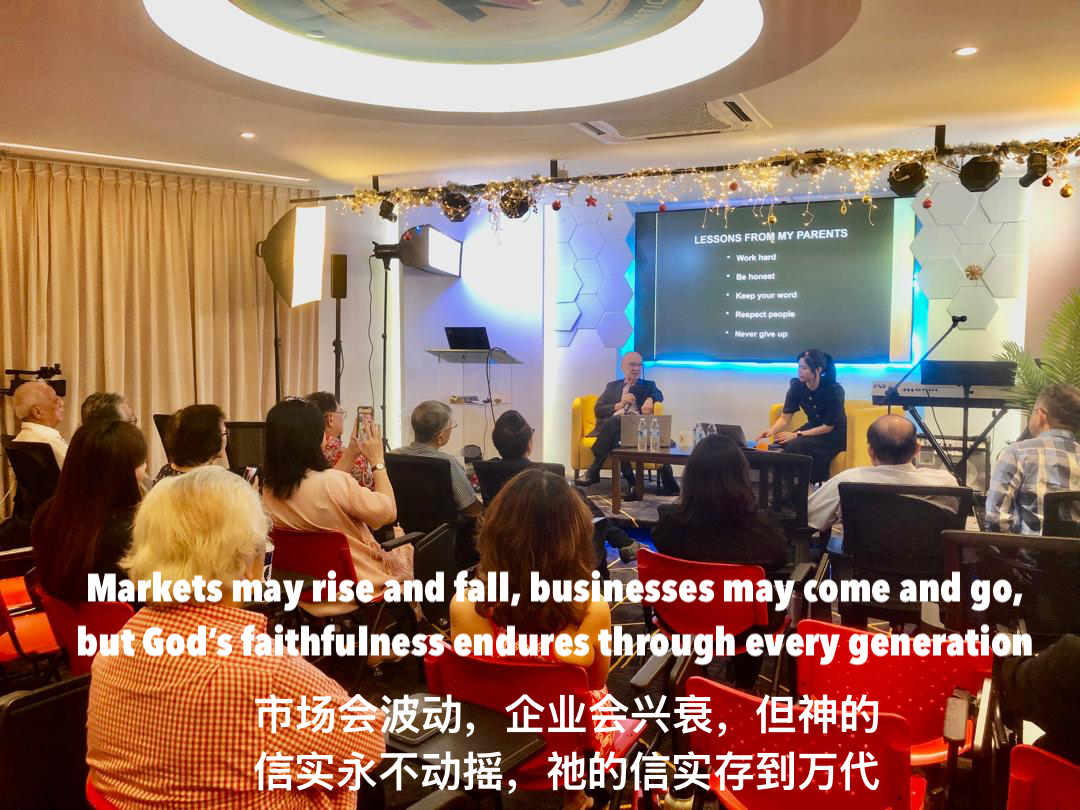
At the TNI Forum on 27 June 2026, participants were deeply encouraged by the sharing of Dato’ George Ting Yew Tong, a pioneering Malaysian business leader who played a significant role in introducing KFC, Pizza Hut, Shakey’s Pizza and Domino Pizza to countless families across Malaysia and Singapore.
What impressed me most was not simply his remarkable business achievements, but his unwavering commitment to honouring Christ throughout his professional journey. His life demonstrates that the marketplace is a mission field. When Christ is at the centre of our work, business becomes far more than a means of earning a living—it becomes a platform for influencing lives, shaping culture, and advancing God’s Kingdom. Through humility, wisdom, integrity, and steadfast faith, Dato’ George exemplified that true success is measured not merely by profits or accomplishments, but by faithfulness to God and service to others.
His testimony beautifully echoes the truth of Psalm 119:90. It reminds us that while people, organisations, markets, and economies continually change, God remains unchanging and faithful. Just as He sustains His creation, He also faithfully guides, provides for, and strengthens His people through every season of life.
Reflecting on my own journey, I realise that every milestone, every breakthrough, and even every trial bears witness to God’s unfailing faithfulness. Whatever has been accomplished has never been the result of human ability alone, but of His gracious hand directing every step and opening doors that no one could have imagined.
Psalm 119:90 calls us to anchor our confidence not in our own achievements, but in God’s unchanging character. Our greatest testimony is not what we have accomplished for God, but what God, in His faithfulness, has accomplished through us. When we remain faithful to Him, our work becomes an instrument through which His glory is revealed and His Kingdom is advanced.
“True success is not measured by what we achieve, but by how faithfully we honour Christ with what He has entrusted to us.”
 DAILY REFLECTION
26 June 2026
“If any of you lacks wisdom, you should ask God, who gives generously to all without finding fault, and it will be given to you."
James 1:5
As TOS has grown and our team has expanded, the truth of James 1:5 has become increasingly evident in our journey. Leading the seminary has continually reminded me of my own limitations. Yet, in every challenge, God has faithfully reaffirmed His promise: whenever we lack wisdom, we can ask Him, and He gives generously without finding fault.
This verse has become a foundational principle for my leadership at TOS. As the seminary continues to grow, so does our need for godly wisdom—not only in making strategic and administrative decisions, but also in developing academic programmes, nurturing faculty and students, and discerning God’s direction for the future. Time and again, as I have sought the Lord in prayer, He has granted clarity, opened unexpected doors, and provided strength far beyond my own abilities.
The growth of our team has also taught me an important lesson: no leader possesses all the answers. God often imparts His wisdom through a community of humble, gifted, and prayerful servants. As we seek Him together, our collective discernment is sharpened, enabling us to make decisions that honour Christ and advance His Kingdom. Our confidence rests not in human expertise but in God’s unfailing wisdom.
James 1:5 reminds us that wisdom is not a one-time gift but a lifelong pursuit. Every new responsibility, opportunity, and challenge calls us to seek God afresh. Rather than relying on our own understanding, we are invited to depend daily on the One who knows all things and delights in guiding His children. As we continue to trust Him, He faithfully provides the discernment, courage, and direction needed to fulfil His calling and accomplish His purposes.
“Every new season requires fresh wisdom, and God never fails those who humbly ask.”

DAILY REFLECTION
25 June 2026
"Do not despise these small beginnings, for the Lord rejoices to see the work begin, to see the plumb line in Zerubbabel's hand." Zechariah 4:10
Last night marked an important milestone with the official launch of the TOS Alumni Association. Although only a small number of alumni joined the Zoom meeting, it reminded me of a timeless truth from Zechariah 4:10: God often begins His greatest works through small and seemingly insignificant beginnings.
We tend to measure success by numbers, resources, visibility, and immediate results. God, however, measures differently. He values faithfulness, obedience, and perseverance. What matters to Him is not how impressive the beginning appears, but whether His people are willing to trust Him and take the first step of faith.
When the Jewish exiles rebuilt the temple under Zerubbabel, many were discouraged because it seemed insignificant compared to Solomon’s magnificent temple. Yet God told them not to despise the day of small things. What appeared small to human eyes was precious to God because it reflected obedience to His will and confidence in His promises.
Throughout Scripture, God repeatedly uses small beginnings to accomplish great purposes. He chose David, a young shepherd, to become a king. He used twelve ordinary disciples to spread the gospel throughout the world. Jesus compared the kingdom of God to a mustard seed that grows into a large tree. These examples remind us that God’s power is not limited by size, numbers, or human resources.
The same principle applies to our lives and ministries today. Every church, ministry, Bible study, discipleship group, and kingdom initiative starts somewhere. Small beginnings teach us humility, patience, dependence on God, and trust in His timing.
Zachariah 4:10 reminds us not to be discouraged by humble beginnings. Remain faithful, keep serving, and trust God with the results. In His hands, small acts of faith and obedience can produce an eternal impact.
“What begins with a few faithful people today may become a legacy that impacts generations tomorrow.”
 DAILY REFLECTION
24 June 2026
“See, I am doing a new thing! Now it springs up; do you not perceive it? I am making a way in the wilderness and streams in the wasteland.”
Isaiah 43:19
Yesterday, the faculty gathered to prayerfully discern the future direction of TOS as a sustainable Christian educational institution. With a desire to serve a wider community more effectively, four educational streams were proposed: the Accredited Stream for pastors and full-time Christian leaders; the Non-Accredited Stream for those seeking systematic biblical learning without the demands of formal accreditation; the Mass Outreach Stream offering accessible talks, podcasts, and short courses on relevant topics; and the Church Package Stream designed to partner with local churches in leadership development and discipleship.
As I reflected on these possibilities, Isaiah 43:19 came to mind: “See, I am doing a new thing! Now it springs up; do you not perceive it?” God often works in ways that are unexpected, opening doors we had not previously considered. What may appear uncertain to us is already part of His divine plan.
Just as God promised to make a way in the wilderness and streams in the wasteland, He continues to guide His people through seasons of change and transition. He creates new opportunities for growth, ministry, and Kingdom impact, even when the path ahead is not yet fully visible.
This verse reminds me not to cling too tightly to the past but to remain attentive to what God is doing today. His faithfulness never changes, and His purposes never fail. As we seek His direction for TOS, we do so with confidence that the God who has led us thus far will continue to guide us into the future.
Isaiah 43:19 encourages us to have eyes to perceive His new work, hearts willing to embrace His leading, and faith to follow wherever He opens the way. For our God is the God of new beginnings, who makes a way where there seems to be no way and brings life-giving streams into the driest places of our journey.
“God’s new direction is never a departure from His faithfulness; it is a fresh expression of it.”
 DAILY REFLECTION
23 June 2026
“My dear brothers and sisters, take note of this: Everyone should be quick to listen, slow to speak and slow to become angry.” James 1:19
After fifty years of marriage, I have learned a simple yet profound truth: a happy marriage is not the absence of conflict, but the choice to keep loving when conflicts arise. It is not a relationship where no one is ever hurt, but one where forgiveness is extended when wounds occur. Marriage is not the union of two perfect people, but of two imperfect individuals who, by God’s grace, learn to accept, support, and grow with one another through every season of life.
When we are quick to listen, we seek to understand before seeking to be understood. Genuine listening communicates love, respect, and value, helping both husband and wife feel heard and appreciated.
Being slow to speak guards us against impulsive reactions. Harsh words can wound deeply, but gracious words bring healing, encouragement, and peace. Likewise, being slow to become angry protects our hearts from bitterness and preserves the unity God desires in marriage. It allows patience, humility, and grace to shape our responses even during disagreements.
By God’s grace, two imperfect people can learn to embrace each other’s weaknesses, celebrate each other’s strengths, and walk together in love. As they grow closer to Christ, they grow closer to one another. Marriage then becomes more than a lifelong partnership—it becomes a living testimony of God’s redeeming love and transforming grace.
James 1:19 reminds us that Christlike marriages are built through daily choices: listening carefully, speaking thoughtfully, and responding graciously. As we yield to the Holy Spirit, our homes can reflect the love, patience, and grace of Christ, becoming a powerful witness to our families and to the world around us.
“A happy marriage is not the absence of conflict, but the daily choice to love, forgive, and grow together by God’s grace.”
 DAILY REFLECTION
22 June 2026
“For God so loved the world that he gave his one and only Son, that whoever believes in him shall not perish but have eternal life.”
John 3:16
During our Father’s Day celebration at Melaka Glory Community Church yesterday, I shared one of the most precious memories of my life—how my father came to know Jesus Christ.
I will never forget the year my father turned ninety.
One day, he suddenly fell unconscious, and I immediately drove several hours to be by his side. When I arrived, my heart nearly broke. The man who had once been strong and full of life was now reduced to skin and bones.
As I gently cut his hair, shaved his beard, trimmed his nails, and wiped his frail body, tears flowed uncontrollably down my face. Seeing my father lying so helpless before me was almost more than I could bear.
In that moment, I whispered a simple prayer: “Lord, please help my father come to know You.”
Then, to my surprise, he slowly opened his eyes and softly asked, “How long have I been asleep?”
I leaned over, embraced him, and said, “Papa, I love you. Jesus loves you too. Would you like to receive Him?”
By God’s amazing grace, he gently nodded.
At that moment, joy flooded my heart. I knew my father had received far more than another day of life—he had received the gift of eternal life in Christ.
By God’s grace, my father lived until the age of ninety-two. I know that that one day I will see him again in the presence of the Lord.
John 3:16 beautifully captures the heart of the Gospel: “For God so loved the world that He gave His one and only Son, that whoever believes in Him shall not perish but have eternal life.” God’s love is greater than our sin, Christ’s sacrifice is sufficient for our salvation, and eternal life is freely offered to all who place their trust in Him.
This experience taught me a lesson I will never forget: the greatest gift we can give our parents is not merely our care, provision, or devotion, but the opportunity to know Jesus personally. The highest expression of filial love is helping those who gave us life to find eternal life in Christ.
May John 3:16 fill our hearts with courage, compassion, and urgency to share the Gospel with those closest to us while there is still time. For the greatest act of love is to introduce someone to the Savior who can give them everlasting life.
“The highest act of filial piety is to lead our parents to the Savior who gives eternal life.”